This is a dedicated site on Filipino genealogy. It is the aim of this blog to discuss, compile, and eventually preserve all types of genealogies available on Filipino families.
Monday, September 2, 2024
Today in Philippine Genealogy: Birth of Antonio Lacuesta in Manila
Tuesday, June 27, 2023
VP Sara has NO Jewish Bloodline!
The online blog Politiko, in a recent post, once more displayed the laziness that many journalists and pseudo-journalists in the Philippines today are wont to be. They rehashed an already debunked claim that the former wife of former President Rodrigo Roa Duterte, Elizabeth Abellana Zimmerman, was the child of a Jewish refugee in World War II. Using this "Jewish connection", Politiko and several other columnists have criticized Vice-President Sara Z. Duterte for opposing the request of the American government to temporarily provide shelter to 50,000 Afghans who are former employees of the US government during their occupation of Afghanistan while they fix their papers. The media has reminded VP Sara that her maternal family, the Zimmermans, benefitted from the benevolence of the Philippine government when her Jewish ancestor was one of German Jewish refugees who found refuge in the country during the Holocaust, so why is she opposing giving safe haven to the Afghans? But the question is, were the Zimmermans REALLY Jewish refugees during World War II, to begin with?
When Vice-President Sara Duterte's father was elected President in 2016, one of the first state visits he made was to Israel. Our relationship with the State of Israel has always been quite special due to the refuge we gave to more than a thousand Jews escaping the Holocaust in Europe. It must be remembered that President Manuel L. Quezon opened our country’s doors to Jewish refugees from Europe during World War II and in so doing saved the lives of more than one thousand and three hundred Jews fleeing the Holocaust. Because of President Quezon’s bold move, known as the Philippines’s Open Door policy, his memory would forever be remembered and known to the Jewish people. He also guaranteed that the world will forever remember that Filipinos have always represented the spirit of compassion, solidarity, and humanity for a very long time, long before the Philippines had official immigration laws or became a State party to the 1951 Refugee Convention, being among the first to voluntarily provide asylum to successive waves of refugees fleeing persecution.
So, naturally, their reception for President Duterte and then Mayor Inday Sara was more than just perfunctory; in fact, the Israelis were more than welcoming due to a claim made by PRRD that his former wife, and the mother of his three children, was the daughter of one of the Jewish refugees aaved by President Manuel L. Quezon's Operation Open Doors. The Israelis embraced Duterte and his daughter like one of their own, especially since the Israeli media made such a big deal of the so-called Jewish connection with a Philippine President.
But all the hoopla about the Zimmermans being Jewish was nothing but the usual unverified oral history in a Filipino family plus the Philippine media's laziness to conduct a simple fact check of PRRD's claims of his former wife's Jewishness. While President Duterte cannot be blamed for believing in the Zimmerman family's oral history, we can put the blame of the media's refusal or inability to verify facts. Here are the facts: Elizabeth A. Zimmerman, the ex-wife of PRRD, was the daughter of two Filipinos: Godofredo Baldazo Zimmerman and Purisima Abellana. Elizabeth Zimmerman's father was born on November 18, 1916 in Hilongos, Leyte, Philippines, baptized on November 25, and died on June 26, 1993 in Davao City, Davao del Sur, Philippines. He was the son of George John Zimmerman and Cristeta Baldazo. Although he used Zimmerman as a last name all his life, both his birth and baptismal records list him under his mother's last name - Baldazo. His birth register in Hilongos, Leyte, while identifying him as illegitimate, does provide the name of his father: Geo. J. Zimmerman.
George John Zimmerman, the grandfather of Elizabeth, was born on January 17, 1890 in Peoria County, Illinois, USA to German immigrants, Michael August Zimmerman and Maria Augusta Wenzel. Michael August Zimmermann, son of Andreas Zimmermann and Marie, was born on July 4, 1857 in Bayern, Germany and died on July 27, 1925 in Peoria, Peoria County, Illinois, USA. He married Maria Augusta Wenzel on July 12, 1883 in Peoria, Peoria County, Illinois, USA. Michael Zimmermann arrived in the United States in 1882. Michael Zimmermann was a tavern owner and true to his surname, also a carpenter.
Sometime after returning to the United States, George Zimmerman married Josephine Mathilde Johnson and they had 3 daughters: Helen May Zimmerman (married name Allyn), Georgiana Zimmerman (married name Ginn), and Josephine Zimmerman (married name Moseley). Descendants of George's daughters are scattered in Washington, Minnesota, and South Carolina.
The Zimmerman lineage of VP Sara comes from Unterlangau, Bavaria, Germany, and German and Jewish genealogists have written that "Zimmermann" (and its variant Zimmerman) is the German equivalent of the English surname carpenter, as it is derived from the profession. The fact that there ARE German Jews with the name Zimmermann does not make it Jewish in origin. Also, census data from the district of Oberviechtach between 1900 and 1939, of which Unterlangau was a part, shows that the district's population was overwhelmingly Catholic back then, with just a single-digit number of Jews. Furthermore, US census and other records list Michael Zimmerman and his family as congregants of the Lutheran Church.
And of course, DNA testing in both the Philippine Zimmermans and their half-relatives in the US have further disproven the Jewish claim. Results from their ancestral breakdown clearly do not show any Jewish heritage. A German-Jewish grandfather (as claimed by Filipino journalists) would have shown up as 25% Ashkenazi Jew, great-grandfather as roughly 12%. But the family's DNA result shows 0%, which means a non-Jewish ethnicity.
The politics of welcoming the Afghan employees of the US government is not the subject of this article. But journalists and columnists must always make sure that before they use genealogical tidbit to make a political point, they must first do a fact check of the information they simply rehash, otherwise they'd end up looking lazy and stupid. The funny and sad thing is that the "Jewish connection" of the Dutertes came from PRRD's unverified oral history, which the Israeli media simply accepted, and then which became the source of Philippine media, as well. So much for journalistic integrity.
Tuesday, January 10, 2023
Common Surnames of Pampanga
Unlike most provinces in the Philippines, many towns of Pampanga have indigenous common family names, although province-wide the top 10 surnames are still Spanish in form. Here are the most common family names of Pampanga and the most common per city and municipality.
Here are the top 10 most common last names in the province of Pampanga, Philippines:
1. Santos
2. David
3. Garcia
4. Dizon
5. Pineda
6. Reyes
7. De La Cruz
8. Mallari
9. Ocampo
10. Mendoza
In the towns and cities of Magalang, Angeles City, Porac, Bacolor, and San Fernando, DAVID is the most common family name.
DIZON is most common in Mabalacat and Mexico.
SANTOS is most common in Floridablanca and Lubao.
GARCIA is most common in Arayat, Guagua, and Minalin.
MANANSALA is most common in Macabebe and Masantol.
Other most common surnames are DE LA CRUZ in Candaba; TARUC in San Luis; SIMBULAN in San Simon; TORRES in Apalit; PINEDA in Santo Tomas; VALENCIA in Santa Rita; MANINANG in Samsuan; and MALLARI in Santa Ana.
Thursday, December 22, 2022
10 Facts About Jose Maria "JOMA" Sison's Genealogy
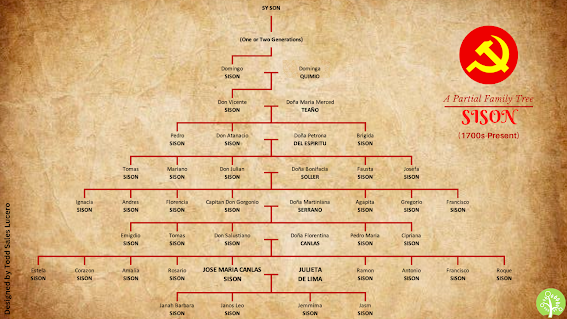
Jose Maria Canlas Sison, founder of the Communist Party of the Philippines, passed away in the Netherlands on December 16, 2022. So today, let us look at his genealogy. He was born to a wealthy family in Cabugao, Ilocos Sur, on February 8, 1939, the son of Salustiano Serrano Sison and Florentina Canlas. Let us explore his genealogy further to see just how well-connected he was.
NUMBER 1: The Sison family is not originally from Cabugao, Ilocos Sur.
![]() |
| The Sison family tree |
While the family of Jose Maria Sison for the last few generations have always called Cabugao, Ilocos Sur as their family home, they were originally from Lingayen, Pangasinan. They only started living there in the mid-1800s when Julian Sison married Bonifacia Sevilleja Suller in 1860 in Cabugao. Before that they were from Vigan, Ilocos Sur, and before Vigan the Sisons lived in Lingayen, Pangasinan.
NUMBER 2: The Sisons are descended from a 16th-century Fukienese ship captain in the merchant fleet of Lin Tao-k’ien named SY SON.
![]() |
| The Sisons of Cabugao |
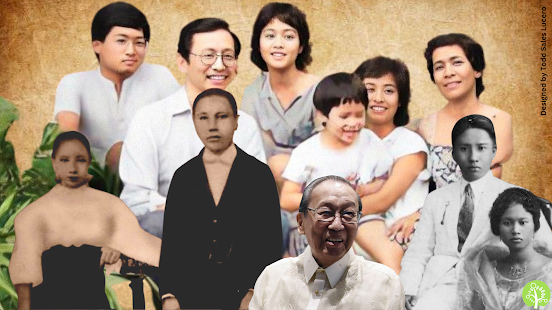
Similar to many Chinese mestizo families, their ancestor, who was said to be a ship captain in the merchant fleet of Lin Tao-k’ien named SY SON who came from Fujian, settled in Lingayen where he quickly assimilated with the local population. By the third generation, the Sisons of Lingayen were already racially classified as mestizos sangleyes or Chinese mestizos and made a living out of being itinerant merchants.
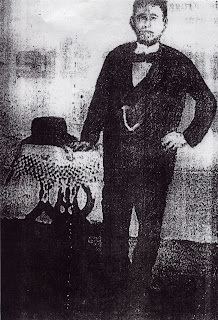
NUMBER 3: His maternal great-grandfather Don Leandro Serrano was the biggest landlord in northern Luzon at the end of the 19th century. Leandro Serrano was the illegitimate child of Don Modesto Solosa y Solla, whose father was also a gobernadorcillo of Cabugao, and Dominga Serrano. A bulk of the Serrano’s wealth came from the Solosa family when Leandro’s grandmother, Dona Maria Solla viuda de Solosa, named him her legal heir and left most of her properties to him. He was also gobernadorcillo of Cabugao for a long time and built the largest mansion in the province. It had 25 rooms, was said to have a total floor space of 5,000 square meters, a chapel, and a four-level storehouse that was considered to be the biggest in the province.
Don Leandro Serrano
Don Leandro Serrano would later marry Ursula Azcueta and one of their children, Martiniana Serrano, was JOMA's paternal grandmother.
NUMBER 4: His paternal grandfather Don Gorgonio Soller Sison was a prominent politician in Ilocos Sur.
Don Gorgonio Sison y Soller was the first generation of the Sison family to have been born in Cabugao, Ilocos Sur. He gave clandestine support to the Filipino guerrillas fighting against the invading Americans while presenting a cordial face to the enemy. He was the last to hold the position of capitan municipal of Cabugao during the Spanish period and then became the first to be elected municipal president during the American period.
He and his wife Martiniana Serrano were the parents of Salustiano Sison, father of JOMA Sison.
NUMBER 5: Jose Maria Sison is related to national hero Jose Rizal.
Though not relatives by blood, a first cousin of JOMA Sison’s father, Jesus Serrano, married into the Florentino family of Vigan, Ilocos Sur. Due to this union, JOMA Sison’s family is then related to the descendants of Jose Alberto y Florentino, the older half-brother of Teodora Alonzo, who was the mother of national hero Jose Rizal who was the son of Lorenzo Alberto Alonzo and Paula Florentino.
NUMBER 6: His father’s cousin Teofilo Sison was a governor of Pangasinan.
Teofilo Sison served as a governor of Pangasinan and was later appointed as the first Defense Secretary during the Commonwealth period. He was convicted in 1946 for allegedly collaborating with the Japanese occupation forces but was given amnesty in 1947.
NUMBER 7: His wife, Julieta de Lima is the third cousin of Senator Leila de Lima’s father.
Ever since Senator Leila de Lima’s incarceration, many have speculated how she and JOMA Sison’s wife Julieta de Lima were related. While some have erroneously concluded that they are sisters, and even some reputable researchers have quickly made her a sister of Senator Leila’s father, the truth is they are distantly related. Senator de Lima herself as late as 2020 stated that they are not cousins, but distant relatives. In another earlier interview, she mentioned that Julieta de Lima was at least third cousin with her father Vicente. In that case, Senator de Lima’s paternal ancestor, Juan de Lima, was the brother of Julieta’s great-grandfather, Pedro de Lima.
NUMBER 8: His family is related to President Fidel Valdez Ramos.
Joma Sison’s grand-uncle, Enrique Serrano, married Maximina Valdez. Because of this marriage, JOMA Sison is thus also related to the Valdezes of Pangasinan, whose most illustrious member is the late former President Fidel Valdez Ramos.
NUMBER 9: He had four children with his wife Julieta de Lima.
Although very rarely mentioned, the Sison family trees online and some other rare references to JOMA Sison and his family mention the names of the children of Jose Maria Sison and his wife Julieta de Lima. These are JANAH BARBARA, JANOS LEO, JEMMIMA, and JASM.
NUMBER 10: The late Sixto Brilliantes, Jr. was JOMA’s cousin.
While it is not hidden knowledge, many still are unaware that the former Commission on Elections Chairperson Sixto Brillantes, Jr. was the second cousin of Jose Maria Sison. They shared a common descent from Don Leandro Serrano, whose daughter Martianiana Serrano was JOMA’s grandmother while her brother, Simeon Serrano, was Sixto’s grandfather.------------------------------------
Sources:
1. Church records of Cabugao and Vigan, Ilocos Sur 2. The Alonzo - Rizal family tree 3. https://josemariasison.org/ primarily the following articles: (1) My Ancestors in the Revolution (2) Sisons in Politics and Government (3) Kinship and Encounters with FVR (4) Sison Family of the Philippines 4. Dispatch from Crame No. 1,000 (https://legacy.senate.gov.ph/press_release/2020/1218_delima2.asp) 5. De Lima: So what if I'm Joma's kin? (https://news.abs-cbn.com/nation/07/30/09/de-lima-so-what-if-im-jomas-kin) 6. The Rizalian Trees: Lineages of Jose Rizal and His Love Interests
Photos except for the family trees are from the josemariasison.org website.
Monday, May 23, 2022
First Lady Liza Araneta Marcos and the House of Araneta
A recent article online which was obviously released to malign incoming First Lady Louise "Liza" Cacho Araneta Marcos, and in effect also take a cheap shot at presumptive President Ferdinand Romuladez Marcos, Jr., was brought to me attention since there was a brief genealogical revisionism found in the article. It read:
Liza's father, Filipino basketball Olympian Manuel Araneta Jr., is a distant cousin of Judy Araneta-Roxas, the mother of former Senator Mar Roxas. Liza's family residence was in Cubao where Mar's family mansion is also located which explains why the two are reportedly close to each other.
This short but very blatant genealogical error clearly shows either the writer being lazy with his research or trying to wrongly illustrate Atty. Liza Araneta-Marcos as a "poor" relation of the Aranetas.
![]() |
| Lineage of Atty. Liza A. Marcos |
Whatever people say, records and genealogies available prove that the pedigree of our incoming First Lady is extensive and established. On her Araneta side, she can trace up to eight generations, while on her maternal line, she can climb 13 generations up the family tree. Aside from the Cachos and Aranetas, she can count as her relatives, whether near or far, the Cojuangcos, the Aquinos, the Pardo de Taveras, the Marcoses, the Macapagal-Arroyos, the Roxases, and many more.
Her maternal side, the Cachos, are one of the most connected families in the Philippines. They all descend from Luisa Azaola, the widow of Davao City’s founder, Don Jose Oyangoren (interesting connection since BBM’s VP is Davao Mayor Sara Duterte). After the death of Don Jose, Luisa remarried to José María González y Brenes. Descendants of Luisa Azaola include:
- Paz Gonzalez de Azaola, the granddaughter of Luisa, married Joaquin Gorricho Pardo de Tavera, the uncle of Paz Pardo de Tavera who was married to Juan Luna (brother of General Antonio Luna);
- Rosario Cacho González de Azaola, a great-granddaughter of Luisa, married Pedro Jose Cojuangco, an older brother of former President Corazon Cojuangco Aquino and uncle of former President Benigno Aquino III;
- Javier Luis Castillejo, a great-great-grandson of Luisa, married Maria Beatriz Preysler Arrastia, sister of Maria Isabel Preysler Arrastia, the mother of singer Enrique Iglesias;
- Maria Angeles Cacho González de Azaola, a great-granddaughter, married Carlos Romulo, Jr., son of Filipino diplomat Carlos P. Romulo.
- Paul del Mar Soriano, a grandson of Marilu Cacho and a 3X-grandson of Luisa Azaola, is married to TV host and actress Toni Gonzaga.
And of course, Liza Araneta Marcos is another direct descendant of Luisa. Liza’s mother, Milagros, is a sister of Rosario Cacho de Cojuangco, Maria Angeles Cacho de Romulo, and Marilu Cacho de Soriano.
On the other hand, Liza is a member of the House of Araneta, one of the most powerful families in the Philippines where four members married into Presidential families:
- Judith Araneta, who married Senator Gerardo Roxas and thus became the daughter-in-law of President Manuel A. Roxas and mother to presidential aspirant Manuel “Mar” Roxas II;
- Jose Miguel T. Arroyo, who married presidential daughter (and later President) Gloria M. Macapagal, thereby becoming both a son-in-law to President Diosdado Macapagal and later First Gentleman;
- Gregorio Araneta, married to presidential daughter Irene Marcos; and,
- Marie Louise Araneta, married to presidential son and presumptive President Ferdinand R. Marcos, Jr.
![]() |
| The Araneta Connections |
The family tree above (click to enlarge) clearly illustrates that the above mentioned article was wrong to say that Liza Araneta Marcos is a distant relative to the Araneta-Roxas family. She is, in fact, a second cousin of Mar Roxas, her father Manuel Araneta, Jr. being the first cousin of Mar’s mother, Judith “Judy” Araneta.
Liza is also closely related to Jose Y. Yulo, a former Speaker of the House, a Supreme Court Chief Justice, and a Cabinet Secretary, who was married to Liza’s grand-aunt Cecilia S. Araneta; as already mentioned, she and former Secretary Mar Roxas are second cousins; former Ms. International Stella Marquez is the wife of of her dad’s first cousin, Jorge Araneta; former first gentleman Mike Arroyo is her fifth cousin once removed; Gemma Guerrero Cruz, former Ms. International and Tourism Secretary and a descendant of Jose Rizal’s sister, is married to Antonio “Tonypet” Araneta, Liza’s fifth cousin twice removed; Irene’s husband, Greggy Araneta, is Liza’s 6th cousin once removed; while Jose Concepcion III, the president and CEO of RFM Corporation as well as a current presidential adviser for entrepreneurship of President Rodrigo R. Duterte.
The most interesting connection of the incoming First Lady is this: even before her marriage to President-elect Ferdinand R. Marcos, Jr. on April 17, 1993, her aunt, Maria Teresa Araneta, married Manuel Abad Lopa, Jr. in 1956, whose brother, Ricardo A. Lopa, would marry Teresa Cojuangco, sister of Corazon Cojuangco Aquino, who would later become President of the Philippines. Interestingly, during the Araneta-Lopa nuptials, one of their sponsors was Daniel Romualdez who in 2 years time would become Speaker of the House of Representatives. In another interesting genealogical twist, this same Daniel Romualdez married Paz "Pacita" Gueco, the first cousin of Ninoy's father, Benigno Aquino, Sr. Thus, incoming First Lady Liza Araneta-Marcos is related to the Cojuangco-Aquino family on both her maternal and paternal sides, with the added twist that her husband's maternal family is also related to the Aquinos.
Clearly, Liza Araneta is not distantly related to the Araneta line of Mar Roxas, as the article stated, but is still closely related being the second cousin of Mar.
The House of Araneta, after all, knows and has accounted for all its members.
Friday, November 26, 2021
Leni Gerona Robredo: Another Daughter of History
While VP Leni Robredo has not always been associated with dynastic politics, her husband’s family has been politically active in Bicol politics, particularly the Villafuerte family, whose maternal line descends from the Robredo, as well. Through her own Gerona lineage, Vice-President Leni Robredo is also a product of the principalia: her Gerona ancestors were cabezas de barangay and gobernadorcillos during the Spanish period, while they also held the position of Presidente Municipal (equivalent to Mayor today) during the American period.
The Geronas were prominent principalia families during the Spanish era, and at least three members of the family, Don Rafael, Don Calixto, and Don Rufino Gerona, served as gobernadorcillo since as early as 1852. As a previous article would tell anyone, though the principalia were of some importance during the Spanish period, having such ancestors was not enough to inflate a family's ego or turn them into oligarchs. In fact, the concept of a principalia was actually as a link of the common people to the Spanish government. When the Americans came, the family's political prominence continued with Rufino, Salvador, Pascual, and Federico Gerona elected as presidente municipal.
Initial research into the Gerona family shows that a brother of the above mentioned Presidente Municipal Salvador Gerona, the son of Casimiro and Senona Gerona, had a brother, Julian, who took a different path in his career. He took up law and was admitted to the Philippine bar. He was one of the foremost Bulaneños of his time, and must have been active in fighting the Americans when they came to colonize the Philippines. In January of 1901 Julian Gerona was sent to the island of Guam together with such famous personalities as Artemio Ricarte and Pio del Pilar. In the official list of prisoners, Julian was listed as holding the position of “colonel”, thus indicating his importance in the fight against the Americans. Julian and the rest did not stay long in Guam, because as soon as peace was restored in the Philippines Julian was back and before long, he was appointed as the first secretary to the First Philippine Assembly of 1907. Julian must have turned a new lead and must have decided to cooperate with the Americans since such lofty position would not have been given to him had he continued fighting against the Americans.
As early as 1903, the aforementioned Don Rufino Gerona was already assisting the Americans in going around town and capturing bandits. In fact, in a report by the commanding officer of the Constabulary force in Sorsogon, Rufino Gerona features prominently as not only guiding the American troops around Sorsogon, but also providing them with local scouts to help in the apprehension of said bandits. The same Rufino Gerona was also mentioned in a meeting of all dignitaries in Sorsogon after the Americans came. The acting governor of Sorsogon, Don Leon Paras, insisted that the salaries of the local officials of Sorsogon be paid the same amount as those of the province of Albay, despite the fact that Sorsogon’s population was just half that of Albay’s. Rufino protested against this, saying that the high salaries were not congruent to their province’s size and that the province’s coffers were not sufficient. Most of all, Rufino Gerona was concerned about the idea of paying officials too high a salary despite the ravages brought about by the war. Clearly, Rufino Gerona was an early crusader against excessive government spending.
One of Secretary Julian Gerona’s sons, Fernando P. Gerona, continued his father's legal profession and became a justice of the peace. The legal profession went another generation when Fernando's two sons and a daughter also became lawyers: Ronando, Fernando, Jr., and Leonor. Another of Julian's sons, Melanio Gerona, married Leonor Nicomedes and they had a son, Antonio Gerona, who later became an RTC judge. Antonio Gerona had been practicing as a lawyer for 19 years when he was appointed judge of the Municipal Trial Court in Cities Branch II on July 9, 1980. He would also later serve as a Judge of the Regional Trial Court Branch 28 in Naga City beginning in January 30, 1987, as well as also taught Law at the University of Nueva Caceres in Naga City. Leni Gerona-Robredo, who is also a lawyer, is the daughter of Judge Antonio N. Gerona and Salvacion Sto. Tomas.
![]() |
| Luisa Azaola |
It is interesting to note that despite the current political contest between former Senator Bongbong Marcos and Vice-President Robredo, there are several historical convergences between them. For instance, while the judiciary is independent, it is very interesting that Vice-President Leni Robredo’s father was in essence also a Marcos appointee. Another connection between them is the fact that during the 2016 elections, one of the contested provinces in the recount in the Vice-Presidential race was Camarines Sur, a bailiwick of Leni Robredo. A former alcalde of Camarines was Don Íñigo González de Azaola, who served from 1809 to 1814; one of his daughters was Luisa Azaola who married José María González y Brenes in 1861. They would later become the great-great-grandparents of Atty. Louise Araneta, who would later marry Senator Ferdinand "Bong Bong" Marcos, Jr. Without a doubt, this ancestor of Presidential hopeful Bongbong Marcos's wife would have circulated among the principalia of Camarines, and would have very well met some of Vice-President Leni's Gerona ancestors, as well.
Maybe a little too speculative, but this is the beauty of genealogy. We get to tell the stories hard-core historians tend to ignore.
Saturday, November 6, 2021
Sara Duterte: Daughter of Destiny and History
Tupas, who was the son of Humabon's younger brother, married Humabon's eldest daughter. This daughter, later baptized as Katherine, was Humabon's child with his first wife, who was the sister of Lapulapu. Thus, the Abellanas, and this includes Mayor Inday Sara Duterte, are not just the putative descendants of Humabon and Tupas, but also collateral descendants of Lapulapu.
A few of the prominent Abellanas in Philippine history were Martin Abellana, the LUDABI (Lubas sa Dagang Bisaya) and “Ang Dagang Bisaya” editor who was born in San Nicolas, Cebu City in 1904; Andres Abellana, a former capitan of the San Nicolas district of old Cebu who, together with his brothers Fabian and Lucas Abellana, were actively involved during the Philippine revolution against Spain in 1898. The three brothers were arrested by the Spaniards after the historic Tres de Abril battle. Andres Abellana's son, Hilario Abellana, became a governor of the province of Cebu (1941-1943).
Historically, the Abellanas have always been considered a true-blue Cebuano family. Legend has it that they are direct descendants of Hari’ Humabon of Sugbu through his grandson, Hari’ Carlos Tupas. This belief is held by almost all members of the Abellana family and is most likely rooted to the fact that, historically, the Abellanas have always been prominent in what is now San Nicolas in Cebu City, said to be the seat of Hari’ Humabon’s kingdom.
Interestingly, the surname Abellana does appear to be almost exclusively Cebuano. While it is found in many parts of the Philippines, it is only in two cities in the province of Cebu where there is a concentration of people carrying it as a last name: in Cebu City, where there are 2,352 people carrying it as a last name and in Talisay City with 790 people with Abellana as a last name. In Cebu City, Abellana is the 37th most populous surname while it is the 5th most common last name in Talisay City. Geographically, Talisay City is adjacent to Cebu City (Philippine Statistics Authority, 2015).
So when I found out that Inday Sara was an Abellana through her mother, Elizabeth Abellana Zimmerman, I immediately realized just how huge the historical and genealogical significance was had she decided to run for the Presidency. Consider these: the year 2021 is the 500th anniversary of the introduction of Christianity in the Philippines. The primary players 500 years ago were Magellan, a Portuguese in the service of the Spanish crown; Hari’ Humabon, who welcomed the Spaniards; Lapulapu, who fought valiantly against the colonizers. Had Inday Sara decided to run for President, she would have been the convergence of all that happened 500 years ago. Her father, the current President, is actually from a family that has always maintained Portuguese descent on one side and Spanish lineage on another. Inday Sara’s mother is a direct descendant of Hari’ Tupas Kamparang and Hara’ Humamai, whose father was Hari’ Humabon and whose mother was a sister of Datu Lapulapu. Inday Sara’s running for President would not just have been an answer to the clamor of the people; it would have been the sacred fulfillment of a destiny carved into Philippine history half a millennium ago.
Amazing what-ifs of history, indeed!
Sunday, July 18, 2021
Did Your Family Adopt its Surname?
Did Your Family Adopt its Surname? Tips on Finding Out Whether Your Family Name is Original or Adopted
Many in the past always
automatically assumed that having a Spanish-sounding family name meant that
they had a Spanish ancestor. This is even quite prevalent today. However, time
and again it has been proven than not all surnames are authentic Hispanic last
names. In fact, as many now have realized, Claveria's 1849 surname decree has
left many Filipino families with the illusion of having Hispanic roots, but in reality,
their surname is merely a byproduct of the decree. Of course, while many
families adopted or were assigned a family name, this does not automatically
mean they could not have a Spanish ancestor somewhere up in their family. So,
the safest rule of thumb is this: though not all families with Spanish-sounding
last names have a Hispanic ancestor, this also does not mean that they do not
have one or two in their family tree. As always, it is necessary to prove one's
family's claim through research and documentation.
In this article, we look at several ways to see if
one's surname was replaced or adopted because of the Claveria decree.
The Timeline: 1850 to 1860
Many people think that just because Governor-General Narciso Claveria y Zaldua promulgated the surname decree on November 21, 1849, people all over the colony began to officially use a family name immediately right after the decree was made. In reality, the decree was not automatically implemented. Typical of the bureaucracy at the time, Claveria’s successor, Antonio María Blanco, had to reinforce the decree and therefore there was a few months’ delay in its actual enactment. Thus, when trying to see if one’s surname is a product of the Claveria decree, one has to note that the actual implementation started around March to June 1850. The reason for the range and not a specific date is due to the difference in the immediate implementation of the decree throughout the archipelago. Some started as early as March while others dragged on with the usual practice until about June of 1850.
When researching one’s family name’s provenance, take note that there is a window of about ten years in most places where one can discern the origin of one’s last name. Focus only on the years 1850 until about 1860, as these are the years where one is most likely to confirm if one’s surname is a Claveria decree by product. There are some municipalities that have longer timeframes, but these unique places are usually the exemption rather than the rule.
Strategy 1: Look at the Notation on the Margins of Parochial Records
If one is lucky to have ancestors coming from towns where the parish priests followed the Claveria decree to the letter, then this first strategy is for you. Many do not know that number 7 in the Claveria decree specifically instructed the towns and parishes that a list of the inhabitants be prepared showing the following: their given name, followed by the family name they have adopted in accordance with the decree, and then followed by the “surname” the person has been using before the decree. The word surname is in quotation marks because not all inhabitants had surnames; in fact, many used a second Christian name after their baptismal name so there were many Maria Concepcions, Jose Franciscos, and so on in one place alone.
Number 19 of the decree further instructed the parish priests to write on the margins of the canonical records the same information as was indicated in number 7 of the decree. See below for a sample.
In this example of a baptismal record from Dingras, Ilocos Norte, from 1878, the name of the child (see upper righthand corner of the record), VITO, is followed by Resureccion, and then by Lazaro. This is just one of the examples of a clear proof of the adoption of a new surname because of the Claveria decree. “Resureccion” is the adopted, formalized last name, while “Lazaro” was the second name of the family of VITO before the decree. The towns in both Ilocos Norte and Sur, though not all but most, seemed to have followed the instructions in the decree faithfully. But, like most cases, Ilocos is an exemption. It would appear that Ilocos’s population was on the verge of making the use of surname official even before the Claveria decree. Around 80-90% of the families in Ilocos by the time of Claveria’s surname decree were already using their father’s second name as a sort of surname, and there was already documentation of many families that have started passing down their “surnames” to the next generation.
If you do not see such notations on the margin of the church records of your hometown, then the second strategy might work for you.
Strategy 2: Look in the body of Parochial Records
While not all parishes followed the decree to the letter, some did still manage to record the old surnames used by their parishioners prior to the decree. In limited instances, the priests noted the new and original surname of the people into the actual body of the record. See below for example.
In the burial record above from 1852, taken from the church archives of Liloan, Cebu, we see that the deceased’s parents, who would have been alive prior to Claveria’s decree, are listed with their original second name. In the first entry, the deceased’s father is Catalino Cuyos Josef, indicated that Cuyos is the new and adopted name while Josef was the pre-Claveria name. The same is true for the entry below, although this time the father’s old second name, Medrano, is actually also a surname. Thus, the Frasco family of Liloan, Cebu, known for Titay’s Rosquillos, who are descendants of the abovementioned Ysabelo Frasco Medrano, used to have Medrano as their second name until changing it to Frasco after Claveria.
Strategy 3: Other State Records
If the second strategy still does not yield anything, try poring through records at the Philippine National Archives, especially the ones with a list of inhabitants or local functionaries. See below for examples.
This first example is an 1852 record of the count of exempted individuals per barangay with the names of the cabezas de barangay listed. Thee are clear examples of families that changed their family names, such as Juan Flores del Rosario, Pedro Aguilar de Sta. Cruz, and Manuel Rabor Bonifacio, clearly indicating that Juan's, Pedro's, and Manuel's new surnames in compliance with Claveria's decree are Flores, Aguilar, and Rabor, respectively, replacing the old second names del Rosario, de Sta. Cruz, and Bonifacio, respectively.
However, there are also others like Santiago Castro, Felipe Quinones, and Romualdo Corro who appear with just one surname, perhaps an indication that they have retained their old surname.
In this second example from Argao, Cebu from 1855, still an inventory of exempted individuals from tribute due to age (reservados por edad) the exempted individuals are listed down. Almost all of the exempted individuals here, who are all above 60 and thus were born way before Claveria’s decree. In Argao’s case, however, only a few families practiced the use of a constant second name which acted more or less like a surname. In the above list, all the listed second names were simply that, a second name, and not a family name. But, this list, as the one above, proves that almost all families in town adopted a surname to comply with Claveria’s decree.
When All Else Fail....
Not everyone is lucky enough to have ancestors from towns with such able parish priests who followed the surname decree down to the last letter. So if none of the above techniques work for you, then you do have to do it the hard way. This will be my next topic in a future post.


